

The Anatomy That Changes Your Differential
CLINICAL REASONING
Dermatomes, peripheral nerve fields and referred pain are three different maps of the same limb. Reading the wrong one is how a cervical spine gets treated as a shoulder for six weeks.
A player walks in with numbness in the hand. You have got fifteen minutes before the next one.
Here is the thing that separates a clean assessment from a wasted six weeks: "numbness in the hand" is not one question. It is three, and they have three different answers, three different structures, and three different treatment plans. The map you reach for first decides everything that follows.
Three maps, one limb
Sensory symptoms can follow a nerve root, a named peripheral nerve, or neither. Those are separate maps laid over the same arm, and they overlap just enough to catch people out.
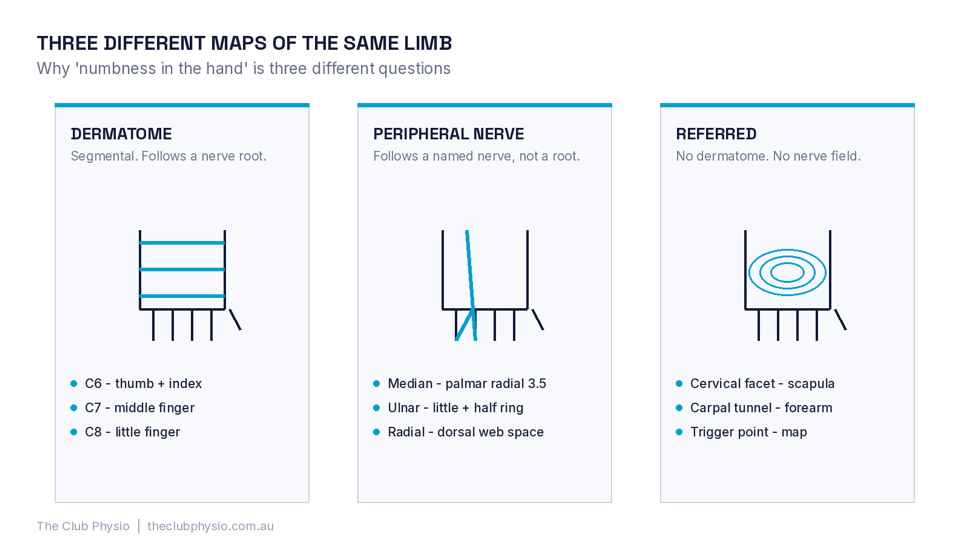
Same limb, three different maps. The pattern tells you which one you are reading.
A dermatome is segmental. It follows a nerve root out of the spine, so C6 gives you thumb and index finger, C7 the middle finger, C8 the little finger and medial forearm. If the symptoms fit a band like that, the cervical spine is in play whether or not the neck hurts.
A peripheral nerve field follows a named nerve well downstream of the root. Median nerve compression at the carpal tunnel gives you the palmar surface of the radial three and a half digits, not a segmental band. Ulnar at the cubital tunnel gives you the little finger and the ulnar half of the ring finger. Radial gives you the dorsal web space. None of those respect a dermatome, because they are not roots.
And then there is referred pain, which respects nothing. A cervical facet joint refers into the scapula and proximal arm with no dermatomal logic at all. A trigger point in infraspinatus refers to the anterior shoulder. Carpal tunnel can radiate proximally into the forearm and occasionally as far as the shoulder, which is exactly the presentation that gets treated as a rotator cuff problem.
Rule of thumb: if the distribution is a band, think root. If it is a glove that ignores bands, think peripheral nerve. If it is neither, and it does not respect any neural map, start thinking referred, and then start thinking about what is referring.
The pattern that costs people the most
The classic miss is not exotic. It is the shoulder that will not settle.
Someone presents with lateral shoulder and proximal arm pain. It behaves a bit like a cuff. It is a bit worse overhead. You load the cuff, you get a small win, then it plateaus and comes back. What was actually happening was a C5 or C6 contribution from the cervical spine, and the giveaway was there in the first session: symptoms that extended past the deltoid insertion in a band, a neck that lost rotation and extension range, and a Spurling's test nobody performed because the neck was not the complaint.
The reverse trap exists too. Not every arm symptom is the neck. Genuine subacromial pain refers to the deltoid region and stops. It does not follow a band into the thumb. If you go looking for a cervical cause in every shoulder, you will find one, because you will treat a stiff mid-thoracic and lose six weeks the other way.
The way through is not more special tests. It is the same short neuro screen, run the same way, every time.
A neuro screen that takes sixty seconds
This is not new information for anyone who has finished a physio degree. The value is not novelty, it is consistency: same order, every time, so you cannot skip a rung and tell yourself you covered it.
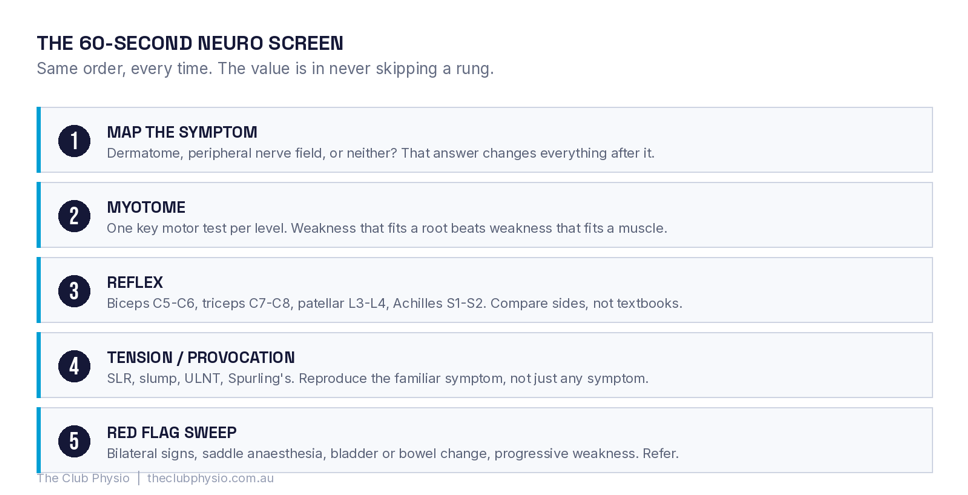
The order matters more than the speed. Skipping a rung is how patterns get missed.
Map the symptom first, because that answer changes everything after it. Then myotome, one key motor test per level: shoulder abduction for C5, elbow flexion and wrist extension for C6, elbow extension for C7, finger flexion for C8, finger abduction for T1. Weakness that fits a root is more informative than weakness that fits a single muscle.
Then reflexes, comparing sides rather than comparing to a textbook: biceps C5 to C6, triceps C7 to C8, patellar L3 to L4, Achilles S1 to S2. Then tension and provocation testing, where the goal is reproducing the familiar symptom, not just producing any symptom. A slump test that makes a hamstring feel tight tells you nothing. A slump test that reproduces the exact pain they came in with tells you plenty.
And then the red flag sweep, which takes ten seconds and matters more than everything above it. Bilateral symptoms, saddle anaesthesia, bladder or bowel change, progressive weakness. If any of those are present, the assessment stops and a referral starts.
The referrals that are not musculoskeletal at all
Two patterns are worth committing to memory permanently, because getting them wrong is a different category of mistake.
The first is shoulder tip pain with no trauma and no mechanical behaviour. Diaphragmatic irritation refers to the ipsilateral shoulder tip via the phrenic nerve, which is the classic presentation in splenic injury, subphrenic pathology and gallbladder disease. In a contact sport context, an athlete who took a blow to the left flank and now has left shoulder tip pain is a medical assessment, not a soft tissue treatment.
The second is knee pain in a child or adolescent. Hip pathology refers to the groin, the anterior thigh and, often, the knee. A slipped upper femoral epiphysis or Perthes disease can present as a limping kid with knee pain and a completely normal knee. Screen the hip in every paediatric knee, every time.
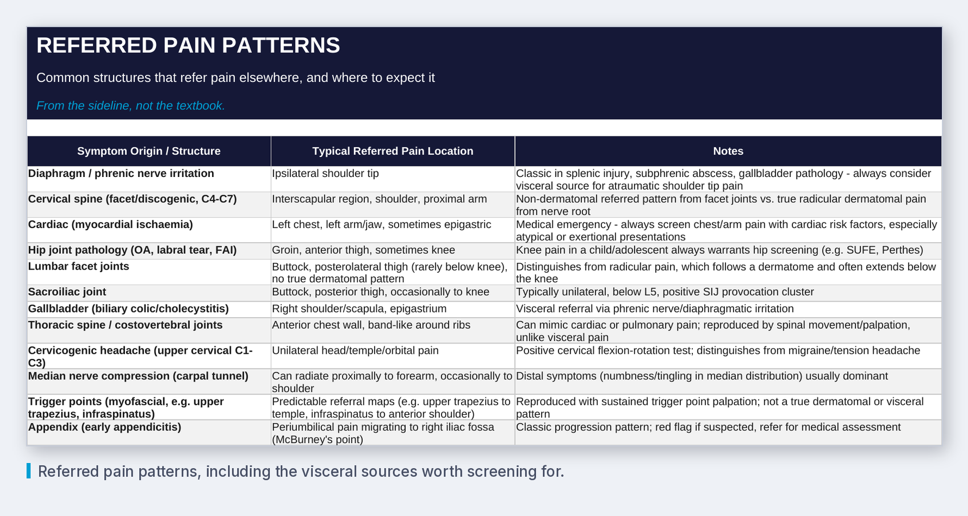
The referred pain sheet from the workbook, including the visceral sources worth screening for.
Why this is a recall problem, not a knowledge problem
Nobody reading this has forgotten that dermatomes exist. That is not the failure point.
The failure point is that on a Thursday afternoon, six patients deep, with a player who needs an answer before training, you are not going to walk to the shelf and open a textbook to check whether the Achilles reflex is S1 to S2 or L5 to S1. You are going to make a call from memory, and memory under caseload pressure is where the small errors live.
That is a systems problem, and systems problems have systems answers. What you want is the specific fact, in under ten seconds, without leaving the room and without losing your train of thought. Not a chapter. Not a two hundred page PDF you have to scroll. One row in one table.
The reference I built for exactly this
This is why the TCP Clinical Anatomy Reference exists. It is a twenty one sheet Excel workbook: ten region sheets covering foot and ankle through to wrist and hand, each with osteology, ligaments, muscles with origin, insertion, action and innervation, nerve supply, special tests and common pathology.
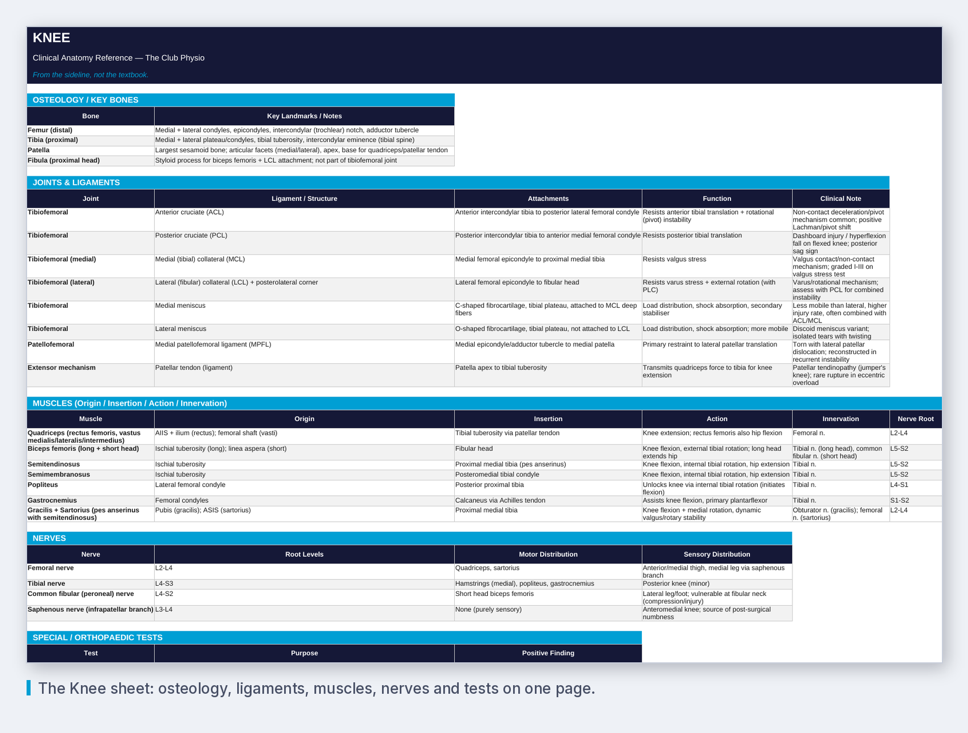
One region sheet: everything for the knee in a single scroll.
Alongside those sit nine cross body reference sheets, which are the ones that get used most: a Muscle Master Table and Ligament Reference that pull every entry from every region into one filterable table, a Special Tests Index, a pathology and differential diagnosis sheet, and dedicated sheets for peripheral nerve pathways, dermatomes and myotomes, referred pain patterns, bursae and vasculature.
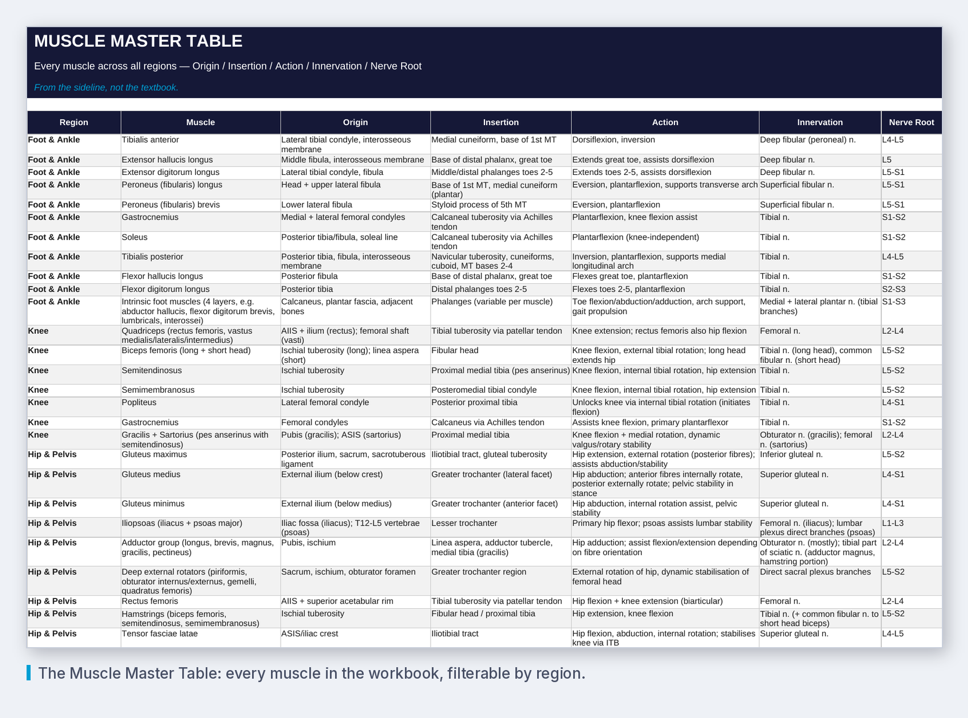
The Muscle Master Table: filter by region, nerve root or innervation and find what you need in seconds.
Because it is a spreadsheet rather than a document, every table filters and sorts. You can pull every muscle innervated by the tibial nerve, or every condition in the hip and pelvis region, or every special test for the shoulder, without scrolling past anything you did not ask for.
Get the Clinical Anatomy Reference
Twenty one sheets. Ten body regions, nine cross body reference tables, fully filterable in Excel, Google Sheets or Numbers.