

The Countermovement Jump: why your jump height means nothing without the curve
The Countermovement Jump: why your jump height means nothing without the curve
Ask most people what a countermovement jump measures and they will say one thing: how high the athlete jumped. It is the number that ends up in the spreadsheet, the one everyone compares, and the one that quietly tells you almost nothing on its own.
Here is the problem. Two athletes can jump exactly the same height in completely different ways. One loads deep and slow and grinds their way up. The other barely dips, snaps off the floor and is gone. Same output, two very different engines, and two very different training plans. The jump height cannot tell them apart. The force-time curve can.
What the CMJ actually tells you
A countermovement jump is a window into how an athlete produces force. When they dip and drive back up on a force plate, you are not just measuring the result, you are watching the whole strategy: how quickly they unload, how hard they put the brakes on, how much force they pour into the push, and how they handle the landing. Read properly, it is one of the most useful and least invasive tests you can run, which is exactly why it has become the workhorse of force-plate testing.
Read the curve, not just the height
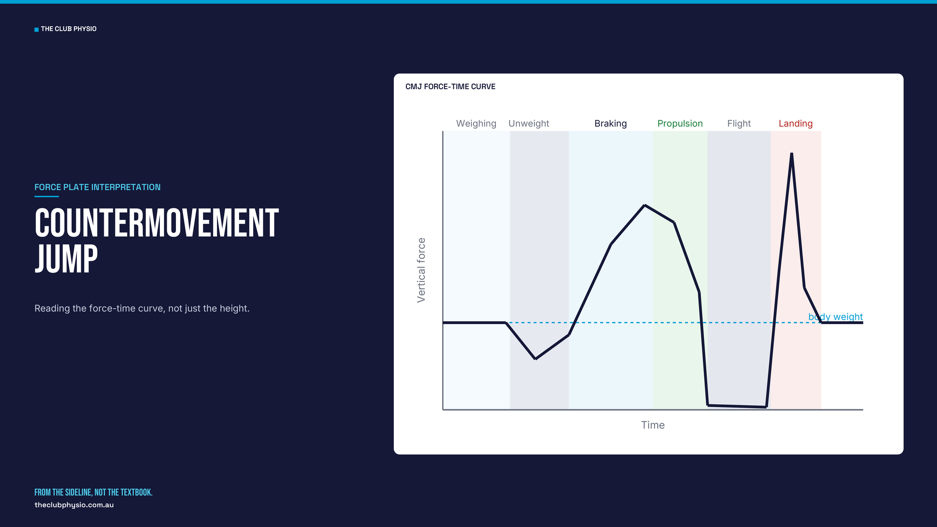
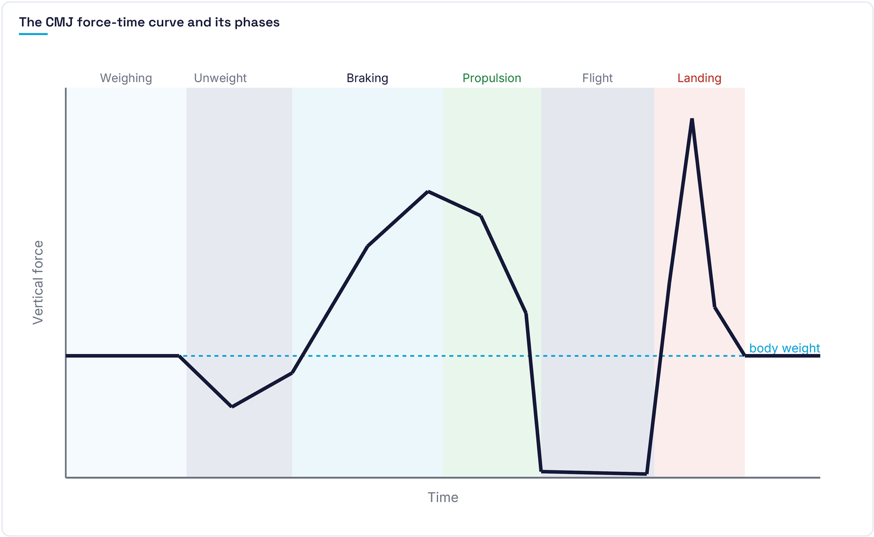
Every countermovement jump moves through the same phases: a quiet weighing period, an unweighting dip as the athlete drops, a braking phase as they reverse it, a propulsion phase as they drive up, then flight and landing. Each phase is a coaching opportunity, and the shape of the curve across them is where the real information lives.
The metrics that matter
Jump height is the output, and you should almost never read it alone. Propulsive impulse is the real driver of how high they go. RSI-modified, jump height divided by the time it takes to leave the ground, is your explosiveness number, and it often tells you more than height about whether an athlete is fast or just strong. And asymmetry, the difference between the left and right leg through braking and propulsion, is the one that matters most for anyone coming back from injury. A good jump height can hide a leg that is quietly doing far less work.
Reading the shape
Once you are looking at the curve, patterns jump out. A deep, slow dip usually means the athlete is using range instead of speed, and a sharper countermovement is the cue. A big spike on landing is a control issue worth a closer look, not just a number to log. And an athlete who loads beautifully but produces little height is telling you they can create force but cannot turn it into movement, which points your training somewhere very specific.
Turning it into training
This is where the test earns its place. Compare an athlete to their own baseline first, not to a table of norms. If you want more height, the message is simple: push the floor away hard and fast, and back it with strength and ballistic work. And never read the CMJ in isolation. Paired with isometric and rate-of-force-development testing, it gives you the full picture of how an athlete makes force, and what to do about it.
Get the free CMJ interpretation sheet
We have put the whole thing onto one clean, print-ready sheet: the phases, the metrics, what the common curve shapes mean, and how to cue and train each one. It is a free download from the store.
Download the CMJ Force-Plate Interpretation Sheet →
From the sideline, not the textbook.