

Clinical Anatomy Reference
The Clinical Anatomy Reference Is Here
Twenty one sheets covering every major body region, plus the cross body tables you actually reach for mid session. Here is what is in it and who it is for.
Every clinician builds the same thing eventually. A folder of screenshots, a notes app full of half remembered nerve roots, three textbooks with the same six pages dog eared. It works right up until the moment you need something quickly.
The TCP Clinical Anatomy Reference is that pile, rebuilt properly. Twenty one sheets, one file, everything filterable.
Ten region sheets
Foot and ankle, knee, hip and pelvis, lumbar spine, thoracic spine and rib cage, cervical spine, head and TMJ, shoulder and shoulder girdle, elbow, and wrist and hand.
Each one covers the same six areas in the same order, so once you know one sheet you know all ten: osteology with the landmarks that matter clinically, joints and ligaments with attachments and function, muscles with origin, insertion, action, innervation and nerve root, nerve supply, special and orthopaedic tests with the positive finding, and common pathology with key clinical features.
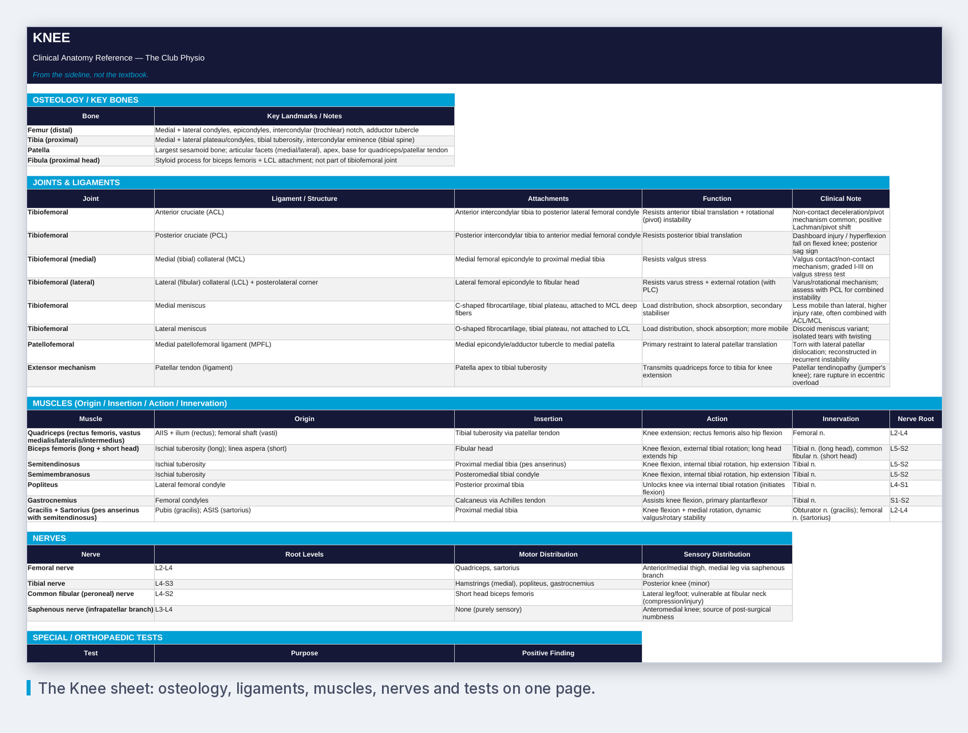
The knee sheet. Same structure on all ten regions.
Nine cross body reference sheets
These are the ones that end up getting the most use.
The Muscle Master Table and Ligament Reference pull every entry from all ten regions into single filterable tables tagged by region, so you can sort by nerve root or scan every muscle innervated by one nerve. The Special Tests Index does the same for every orthopaedic test in the workbook, and the pathology sheet lets you scan differentials across regions rather than one at a time.
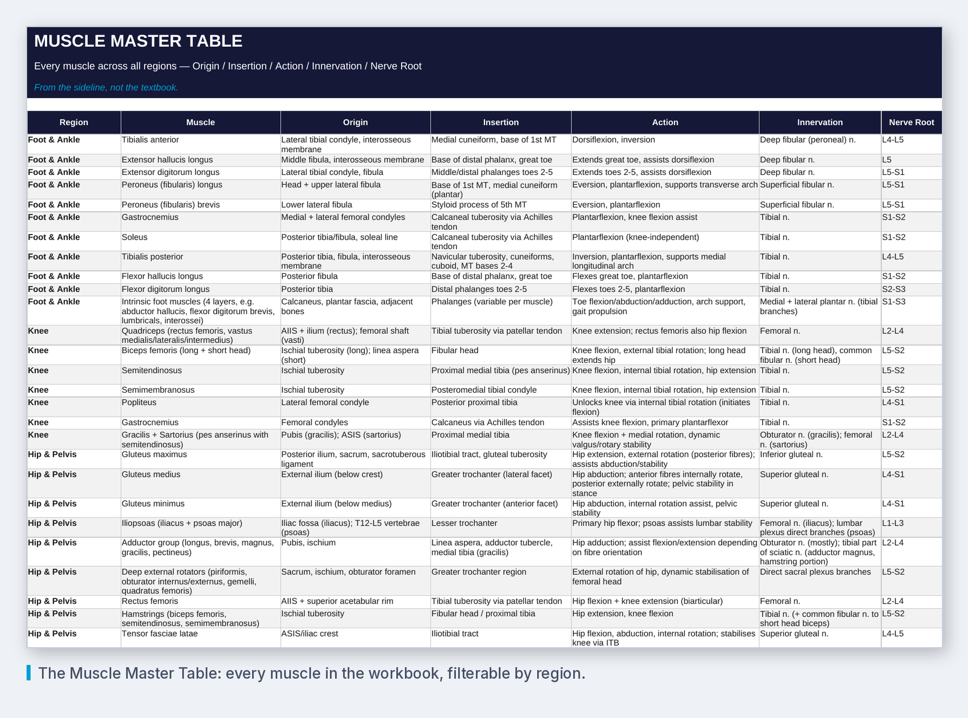
Every muscle in the workbook, in one sortable table.
Then there are five body wide sheets that do not belong to any single region: peripheral nerve pathways covering the brachial and lumbosacral plexus with course and entrapment sites, dermatomes and myotomes, referred pain patterns including the visceral sources worth screening for, bursae, and vasculature with the palpation points that matter.
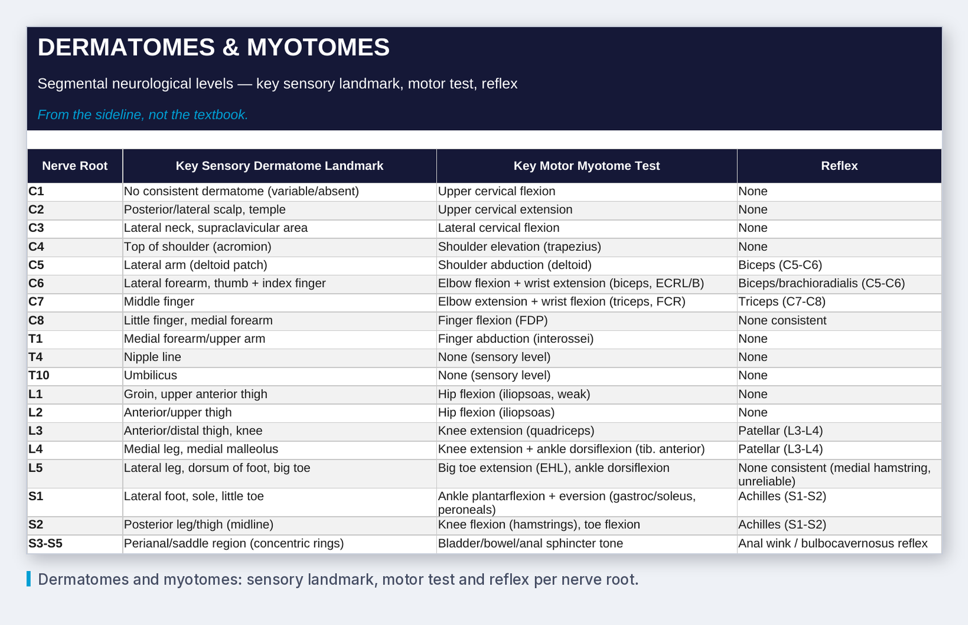
Dermatomes and myotomes, laid out for a screening exam rather than an exam paper.
Why a spreadsheet and not a PDF
A PDF is a document you read. A spreadsheet is a database you query, and that is a meaningfully different thing when you are mid session.
Every table has filtering enabled. Want every muscle with an S1 contribution? Filter the nerve root column. Every special test for the shoulder? Filter by region. Every condition that presents with groin pain? It is two clicks. There is also a clickable contents page so you can jump straight to any of the twenty one sheets, and a how to use page with the clinical disclaimer.
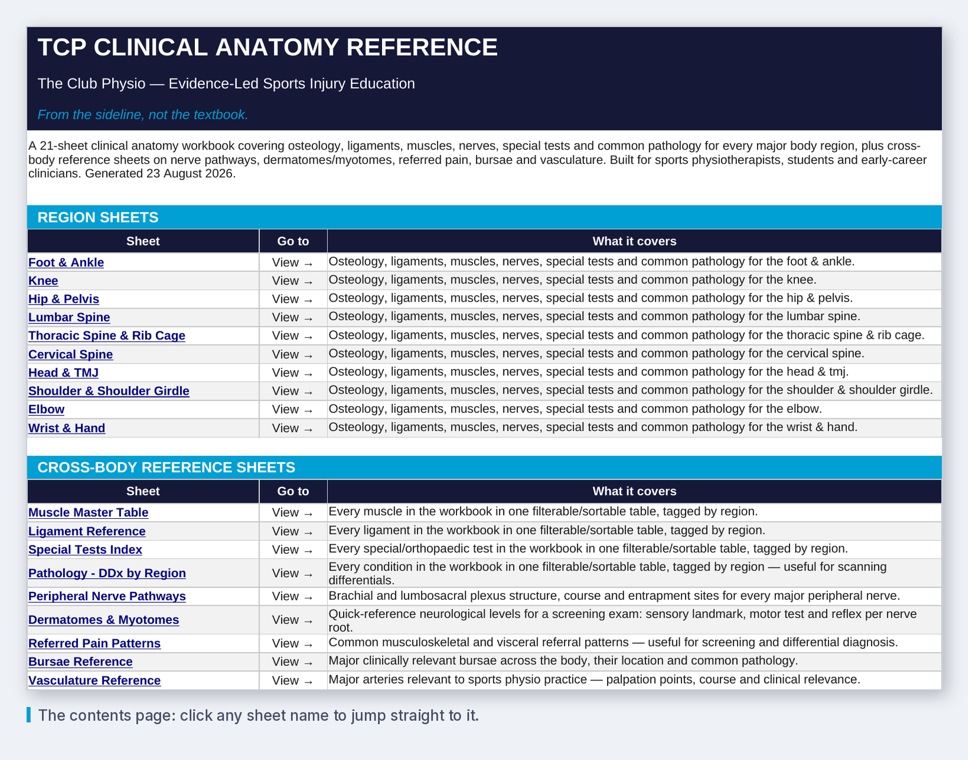
The contents page. Click any sheet name to jump to it.
Who it is for
Sports physios who want exam ready recall without leaving the treatment room. Students revising for practicals and clinical placements, where the muscle tables and myotome sheets do most of the heavy lifting. And early career clinicians building a reference library from scratch.
It works in Excel, Google Sheets and Numbers, so it goes wherever you do, including on an iPad on the sideline.
One honest caveat, which is also written into the workbook itself: this is a quick reference tool, not a replacement for primary anatomy texts or current clinical guidelines. Verify anything you are going to hang a clinical decision on. It is built to save you the ten seconds, not to do the thinking for you.
Get the Clinical Anatomy Reference
Twenty one sheets. Ten body regions, nine cross body reference tables, fully filterable.
Download the Clinical Anatomy Reference →
From the sideline, not the textbook.